My Garden Genie Sign in

A garden book that knows your ground.

My Garden Genie is a notebook for a vegetable garden in Ireland or the UK. It knows what to sow this month for your own weather station, draws your beds and your polytunnel, keeps a diary with photos and a sowing chart, reads the forecast for your exact spot, and carries a library of 141 crops written for a mild wet garden and checked against their sources.

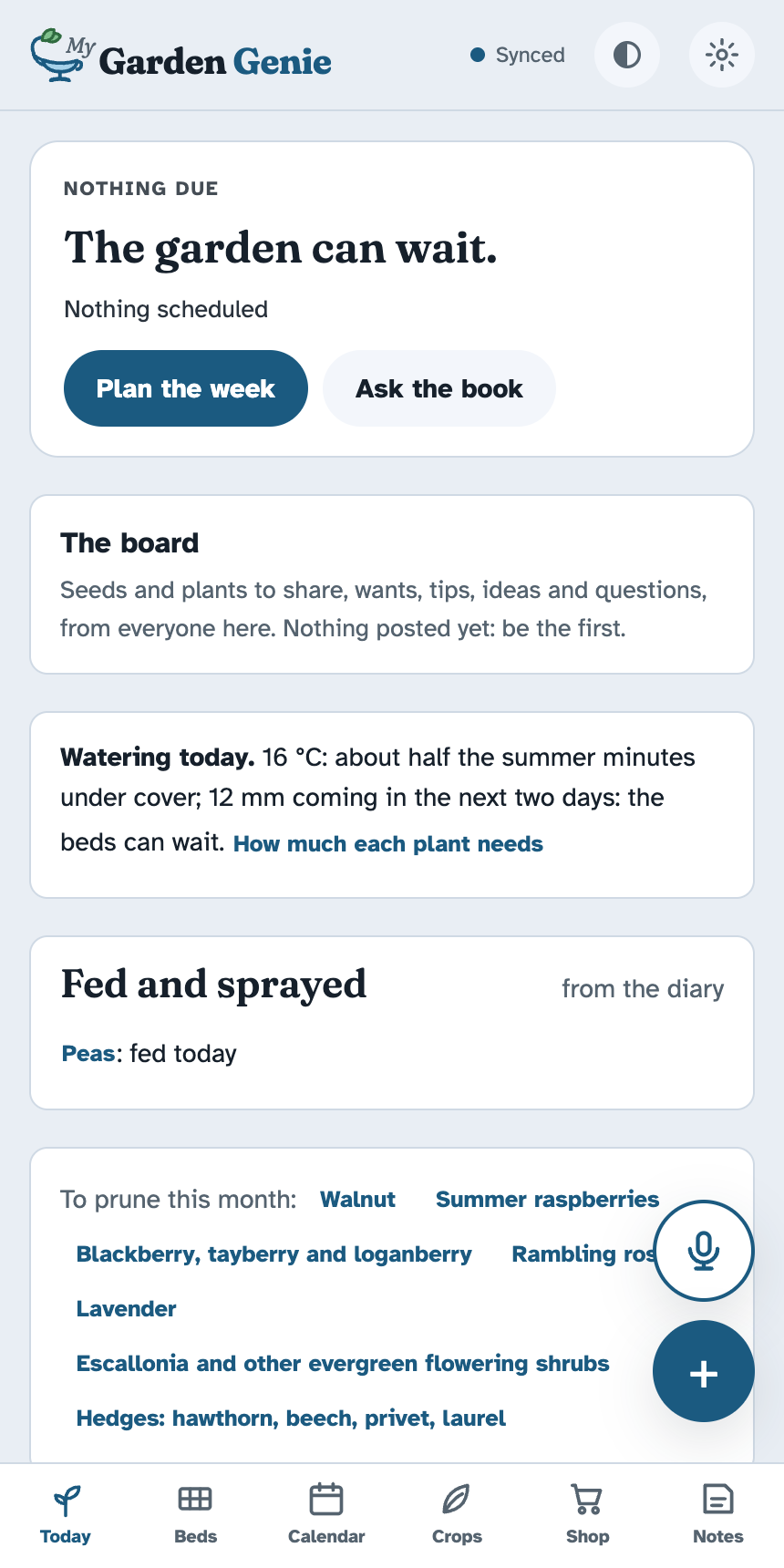
My Garden Genie's Today page on a phone: the one thing to do, the week's weather, and what is coming in
What it does

One page a day, and everything behind it

Open it in the morning and Today tells you the one thing to do, what the week's weather means for it, what is coming in, and what the diary says was last fed or sprayed. Everything else is a tap away.

The Today page

Today

The next job chosen for you, the frost watch for your station, the forecast strip (tap a day for its hours and its jobs), the glut coming in, watering for the day, your plants to prune this month.

The polytunnel designer

Beds and the polytunnel

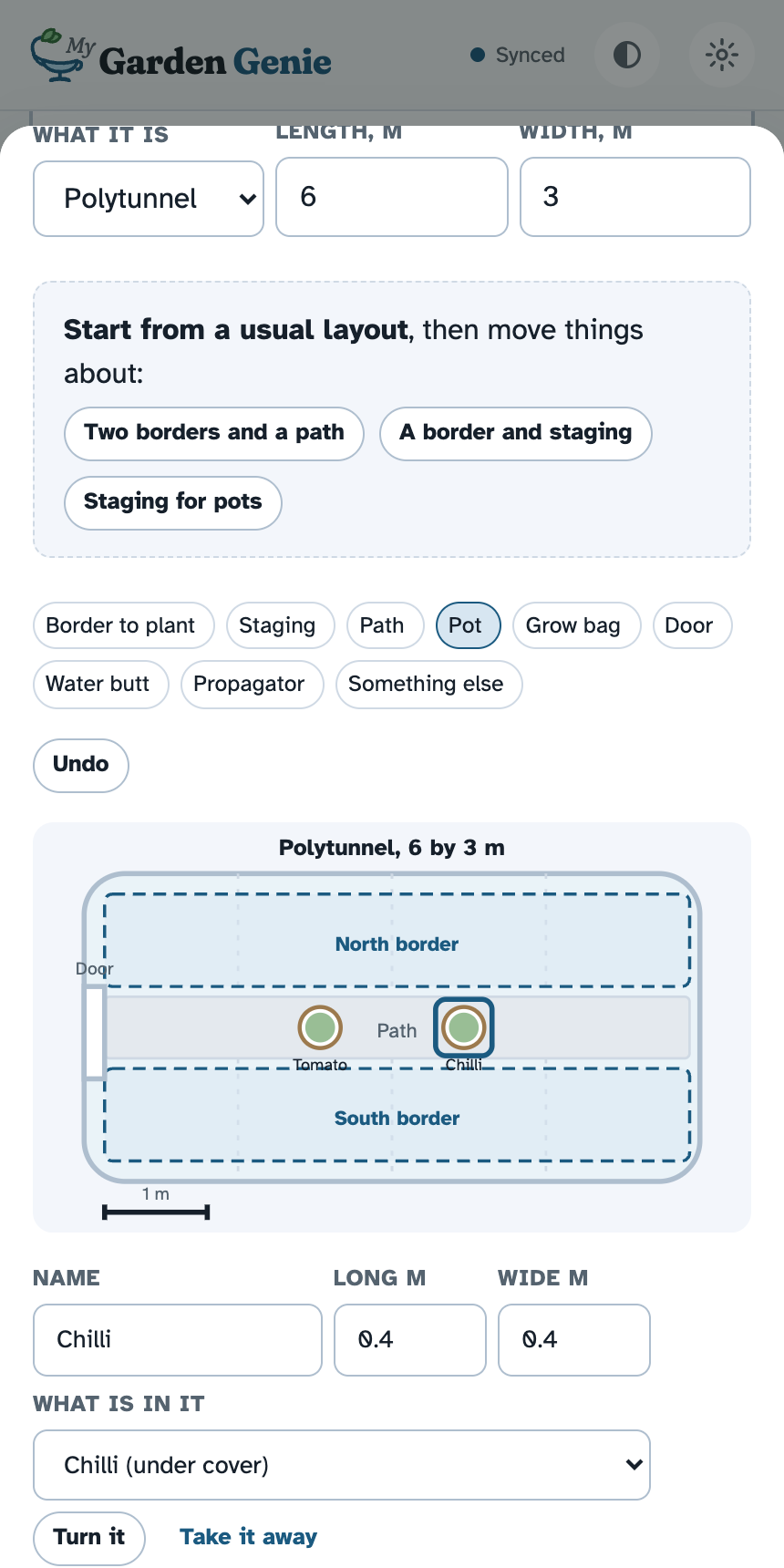
Draw the plot and the beds; draw the inside of the tunnel or greenhouse with its borders, staging, pots and grow bags. Plant a border and it becomes a bed with its own plan, its own year and its own progress photos.

The sowing chart

The sowing chart

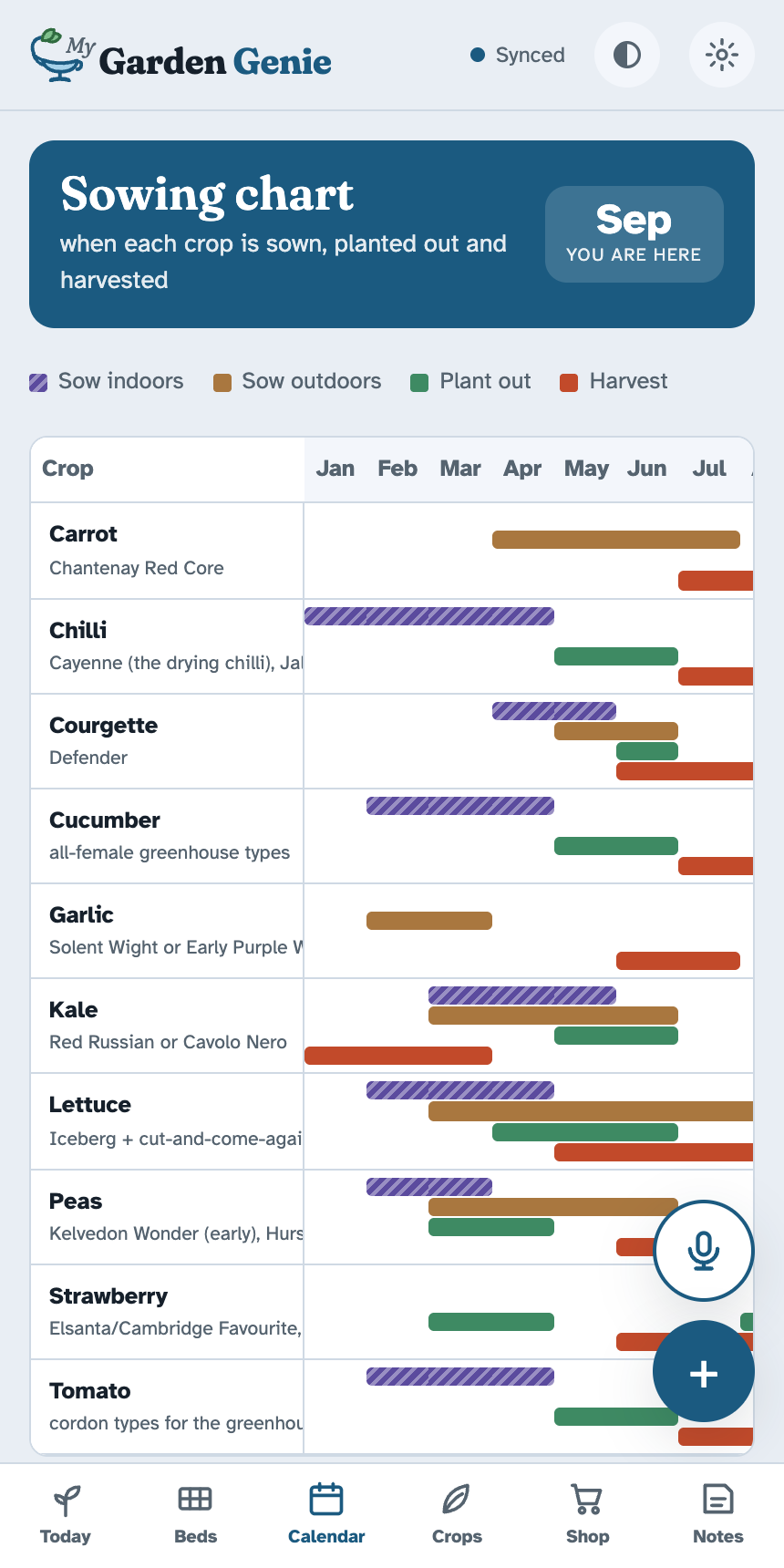
Every crop across the year: indoors, outdoors, planting out and picking, with this month marked. Sowings you log turn into the jobs that follow: pot on, plant out, feed, pick.

A crop page with its photos

A page for every crop

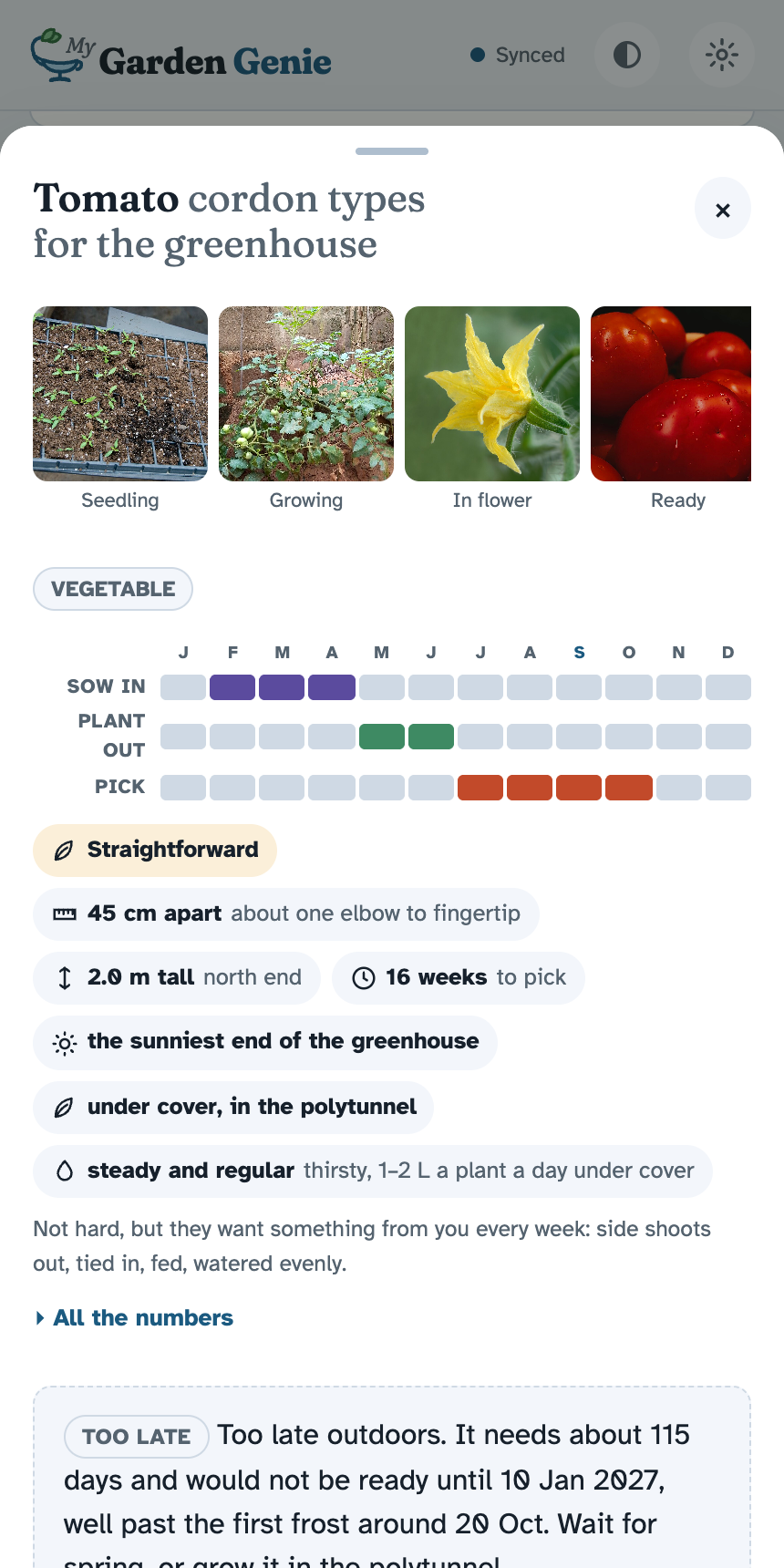
The plant at four stages, the months, the spacing in body measures, how much water it wants, what to feed it, the little secrets that make the difference, companions, varieties and what each is for, where to buy it, and what to do with a glut.

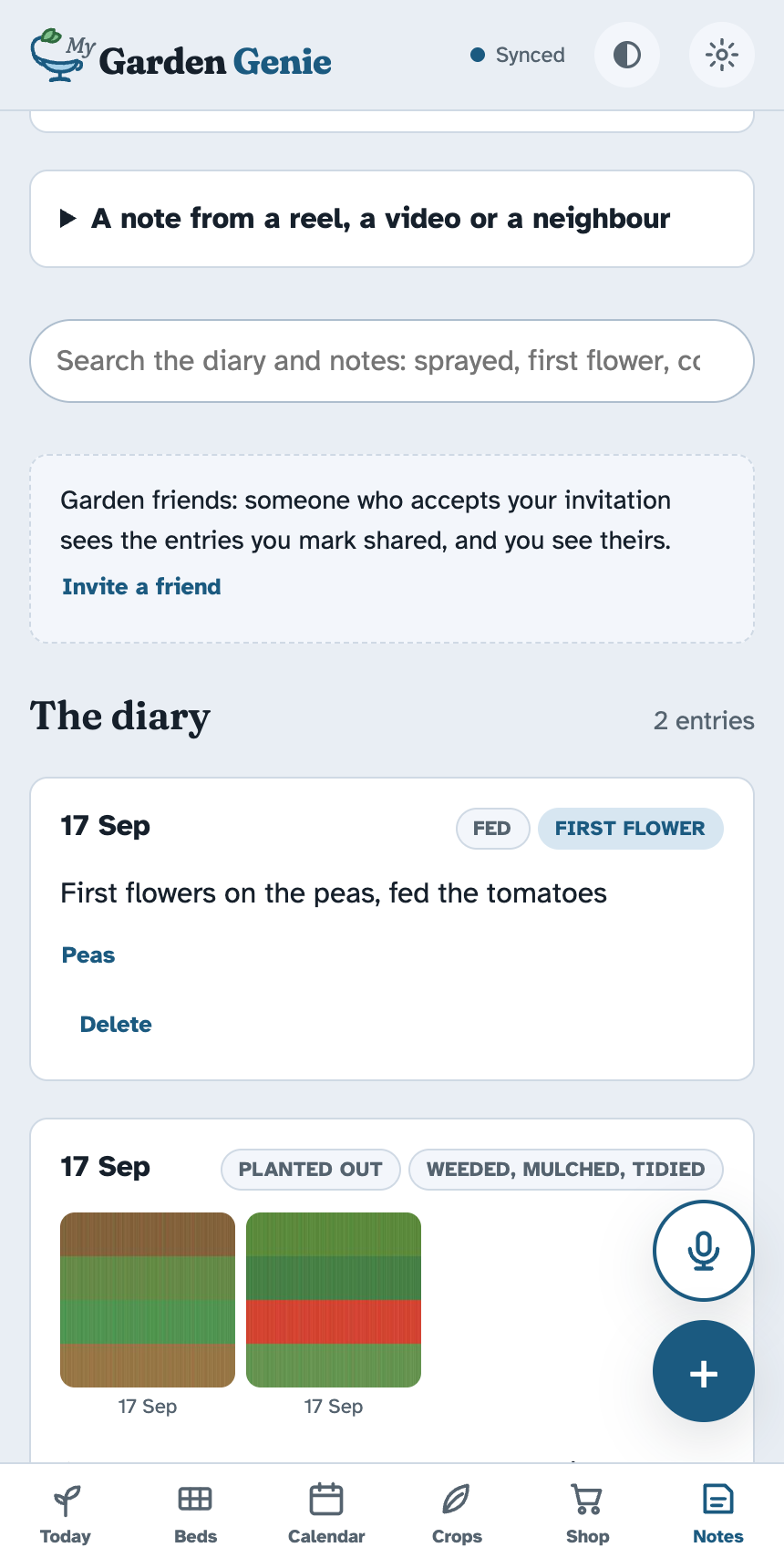
The diary

The diary

What happened today, typed or dictated: sowed, planted, fed, sprayed, first flower, harvested and how much, with photos. Searchable; read back on each plant's page and each bed's, harvests added up.

The library

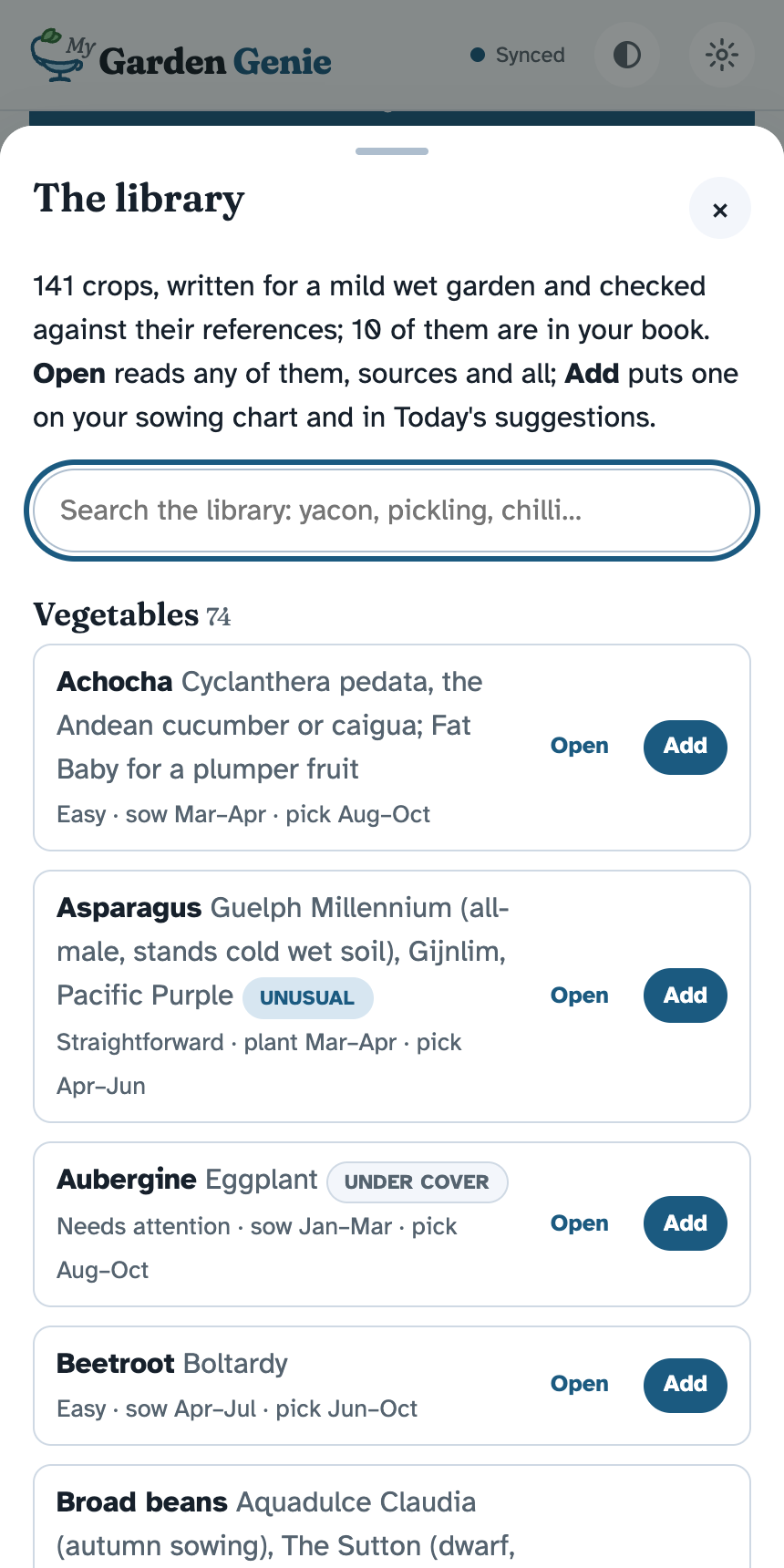
The library

141 crops, from the potato to the Buddha's hand, each written for this climate and checked against the reference it names. Read any of them; add the ones you want to grow.

Install

It is a web page that lives on your phone

iPhone or iPad

Open the address in Safari and sign in, so the book itself is on the screen. Tap the Share button, then Add to Home Screen. My Garden Genie then opens like any app, full screen, and works without a signal once it has loaded.

Android

Open the address in Chrome and sign in, so the book itself is on the screen. Tap the three dots, then Add to Home screen or Install app. Same result: an icon, full screen, works offline.

Computer

Any browser. The same book, the same sign-in; the drawings are easier with a mouse, the photos easier from the phone.

Signing in

With a Google account, or with a one-time link sent to your email. Nothing to remember. My Garden Genie is by invitation at present: ask the gardener who told you about it.

How to use it

Three minutes to set up, then a minute a day

  1. Set up the garden. Where it is (a postcode or a place name finds it), which weather station's frost record to plan against (the nearest is picked for you), whether you have a greenhouse or a polytunnel, a hot compost bin, hens, and which crops to start with. Everything can be changed later.
  2. Draw the beds. Under Beds, lay the plot out and draw each bed; a bed's page keeps its plan for the year, what worked and what did not, and its photos. Draw the tunnel or greenhouse the same way.
  3. Log what you sow. A sowing becomes the jobs that follow, dated for your frost record. Today shows the next one.
  4. Write the diary. A line and a photo when you do something: fed, sprayed, first flower, picked and how much. Tap the microphone and say it. The crop pages and the bed pages read it back.
  5. Read the library. Under Crops, every crop the app knows; add what you fancy, and try something new from the unusual corner: oca, skirret, achocha, the luffa.
  6. Let it nudge you. Turn on the evening nudge in Settings and the phone tells you at the hour you choose: frost tonight, the job for tomorrow, a plant due a feed, a hot day coming for the tunnel.
Together

Your book is yours; what you share is your choice

Garden friends

Invite someone; once they accept, each of you sees what the other marks shared in the diary, photos and all, and nothing else. Either can end it.

The board

Seeds and plants to share, wants, tips, ideas and questions, from everyone here. A post can be tied to a crop or the hot bin, and then shows on that page.

About me

A name to go by, where you garden, your story and a photo if you wish. Tick a box to welcome invitations and you appear on the gardeners list.

Privacy

Your book lives on a server in the EU. Nothing in it is seen by anyone unless you share it, and no one is tracked. Your place is used for the forecast and the sun; your sign-in address is never shown to other gardeners.

Where it comes from

Knowledge, not memory

The text of the library was written with a language model and a gardener together, and what makes it knowledge rather than memory is the reference each record names and the check recorded against it. Every crop page names its sources. The full tally, crop by crop and what has been checked against what, is kept for whoever looks after the library; it is about the library, never about anyone’s own garden.

About us

It started with a list, and got out of hand

We are a family of four and love fruits and vegetables. We live in the west of Ireland in a little town called Claregalway, just outside Galway.

A few years ago, I made a hopeless attempt to grow some vegetables in the garden, which I had sown and raised in the conservatory in early spring, and planted out in the garden. Most of the plants got eaten by slugs in no time.

Last September, I decided to get a polytunnel, mostly to have an outside relaxing area without the winds, rain, but with some warmth and sun. I filled it with a nice seating area and tropical plants, just to realise in late autumn that it would be impossible to keep my lovely space warm.

In early spring, the growing bug hit me, and I made a long list of seeds to grow, without much knowledge and with the help of many videos and books. During the season, I saw a few plants thriving (my tomatoes turned into monsters but the fruits are delicious), while my courgettes just got one issue after another. Not to mention all the pests (ants, aphids, you name it) that I tried to tackle with organic over-the-counter items and YouTube suggestions. In the end, I used some grow bags and once outside, my courgettes just got going. We had a nice little harvest giving me a taste for more.

By the end of the summer, I had decided that next spring, I would give beds a go. I am not a patient person and I don’t think small but I do not have a lot of time to spend in the garden thanks to school and sports runs, not to mention my day job. So I got books on how, when, what to plant, watched endless reels, made (again) a long list of what I would like to grow. And I started a book, yes paper-based, taking notes on what worked in the polytunnel, what did not work, and tips and tricks that others had posted.

Then, I went ahead and planned the outside garden – while I will start small (with 4 beds only!) ambitious me is already planning ahead for future expansion. Of course, I again spent hours looking for garden designs, sketching on paper what I liked and what a final design could look like. Then, I needed to plan each of my four beds around my long list of vegetables and fruits that I want to grow. So, I started collecting information on when, how, and with which other companion plants, while trying to map them into the beds such that they would look natural and not farm-like, exactly like the Instagram-ready pictures and reels showed it.

By this stage at the latest, I got completely overwhelmed, trying to keep up with my notes, my layout, and an ever-growing wish list. There was a moment when I felt completely lost in all the information, not knowing how to organise them, let alone how to fit all of the tasks ahead in my already busy schedule. I decided to do what I do best – work on the solution, rather than the problem. In my case, it meant sitting down at the computer and starting to program my little helper.

With every new piece of information I gathered or I needed to consider, I added a new feature. My Garden Genie became what I needed – it has all information, tips and tricks, available to me where I need it most – in the garden, at the shop, when deciding whether to get just another seed packet, …

I showed it to friends and family, and the rest is … now also at your fingertips. Happy gardening.

Ines